Using Python to access IBMs quantum computers

In a previous post, we have looked at IBMs Q experience and the graphical composer that you can use to build simple circuits and run them on the IBM hardware. Alternatively, the quantum hardware can be addressed using an API and a Python library called Qiskit which we investigate in this post.

Installation and setup

To be able to use Qiskit, there are some setup steps that we need to complete. First, we obviously have to install Qiskit. This is easy – we can simply use pip.

pip install qiskit

This will download the latest version of Qiskit, in my case (at the time of writing this) this was version 0.6.1. The next thing that you need is an API token to be able to access the IBM API. Assuming that you are already a registered user, you can create your token on the advanced tab of your user profile page.

In order to easily access your token from a Python script, it is useful to store the token locally on your hard drive. Qiskit uses a file qiskitrc in the ~/.qiskit folder in your home directory to store your credentials. The easiest way to create this file is the following code snippet

python -c 'from qiskit import IBMQ ; IBMQ.save_account("your_token")'

where obviously you need to replace the text inside the quotes with your token. After running this, you should find a file ~/.qiskit/qiskitrc containing your saved token (in clear text).

Once that file is in place, you can now easily load the credentials from within a Python program using the following code snippet

from qiskit import IBMQ
IBMQ.load_accounts()

The method IBMQ.active_accounts() will also return a list of currently available accounts which can be useful for debugging purposes. Loading an account is only needed if we want to connect to the IBM site to use their quantum hardware or the online simulator, not if we use a local backend – more on this later.

Circuits, gates and measurements

Let us now take a look at the basic data structures of Qiskit. A QuantumCircuit is what you expect – a collection of gates and registers. In Qiskit, a circuit operates on a QuantumRegister and optionally contains a ClassicalRegister which holds the results of a measurement. The following code snippet will create a quantum register with two qubits, a classical register with two qubits and a quantum circuit based on those registers.

from qiskit import QuantumCircuit
from qiskit import ClassicalRegister
from qiskit import QuantumRegister
q = QuantumRegister(2,"q")
c = ClassicalRegister(2,"c")
circuit = QuantumCircuit(q,c)

Next, we need to add gates to our circuit. Adding gates is done by calling the appropriate methods of the circuit object. The gate model of Qiskit is based on the OpenQASM language described in [1].

First, there are one qubit gates. The basic one qubit gates are rotations, defined as usual, for instance

R_X(\Theta) = \exp \left( -i \frac{\Theta}{2} \sigma_X \right) = \cos \frac{\Theta}{2} - i \sigma_X \sin \frac{\Theta}{2}

and similarly for the other Pauli matrices. Now it is well known that any rotation of the Bloch sphere can be written as a product of three rotations around y- and z-axis, i.e. in the form

R_Z(\Phi)R_Y(\Theta)R_Z(\lambda)

which is denoted by

U(\Theta,\Phi,\lambda)

in OpenQASM and Qiskit. For instance, U(0, 0, \lambda) is a rotation around the z-axis and so forth. A short calculation shows that

U(\Theta,\Phi,\lambda) = \begin{pmatrix} \exp \left(-\frac{i}{2}(\Phi + \lambda)\right) \cos \frac{\Theta}{2} & - \exp \left(-\frac{i}{2}(\Phi - \lambda)\right) \sin \frac{\Theta}{2} \\ \exp \left(\frac{i}{2}(\Phi - \lambda)\right) \sin \frac{\Theta}{2} & \exp \left(\frac{i}{2}(\Phi + \lambda)\right) \cos \frac{\Theta}{2} \end{pmatrix}

Other gates can then be built from this family of one qubit gates. When it comes to multi-qubit gates, the only multi-qubit gate specified by OpenQASM is the CNOT gate denoted by CX, which can then again be combined with other gates to obtain gates operating on three and more qubits.

For qiskit, the available gates are specified in QASM syntax in the file qelib1.inc (see https://github.com/Qiskit/qiskit-terra/blob/master/qiskit/qasm/libs/qelib1.inc). Note that global phases are suppressed, so if you carry out the calculations, you will sometimes find a difference in the (unimportant) global phase between the result of the calculation and the results in Qiskit.

There is a couple of gates that you will often use in your circuits and that are summarized in the following table.

Gate Description
X Pauli X gate
Y Pauli Y gate
Z Pauli Z gate
S Phase gate \text{diag}(1,i)
T T gate \text{diag}(1,e^{i\frac{\pi}{4}})
CX CNOT gate

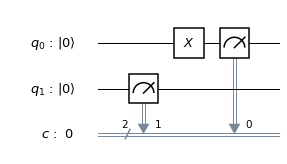
Gates take arguments that specify the qubits on which the gates operate. Individual qubits in a register can be addressed using an array-like notation. For example, to implement a circuit that applies an X gate to the first (least significant) qubit and then a controlled-NOT gate with this qubit as control qubit and the second qubit as target qubit, the following code can be used.

q = QuantumRegister(2,"q")
c = ClassicalRegister(2,"c")
circuit = QuantumCircuit(q,c)
circuit.x(q[0])
circuit.cx(q[0], q[1])

On real hardware, CNOTs can only be applied to specific combinations of qubits as specified in the coupling map of the device. However, when a circuit is prepared for execution on a specific device – a process called compilation – the compiler will deal with that by either reordering the qubits or adding additional swap operations.

Now we have gates, but to be able to run the circuit and measure the outputs, we still need measurements. These can easily been added with the measure method of a circuit, which accepts two parameters – the quantum register to measure and the corresponding classical register.

circuit.measure(q,c)

When the measurement step is reached during the processing of the circuit, the measurement is done – resulting in the projection of the state vector to the corresponding subspace – and the results of the measurements are copied into the classical register from which they can then be retrieved.

A nice property of Qiskit is its ability to visualize a quantum circuit. For that purpose, several classes called drawers are available in qiskit.tools.visualization. The circuit above, for instance, can be plotted with only one command

from qiskit.tools.visualization import matplotlib_circuit_drawer as drawer
my_style = {'cregbundle': True}
drawer(circuit, style=my_style)

and gives the nice representation

CNOT

Compiling and running circuits

Let us now actually run the circuit. To do this, we need a Qiskit backend. Qiskit offers several backends. The Aer package contains a few simulators that are installed locally and can be executed directly from a Python script or a notebook. Some of these simulators calculate the actual state vectors (the unitary simulator and the state vector simulator), but cannot deal with measurements, others – the QASM simulator – only provide statistical results but can simulate the entire circuit including measurements.

The IBMQ package can be used to connect to the devices offered by the IBM Q experience program, including an online simulator with up to 32 qubits and the actual devices. As for the composer, accessing the IBM Q experience devices does obviously require an account and available units.

In order to run a circuit, we first compile the circuit, which will create a version of the circuit that is tailored for the specific hardware, and then submit the circuit as a job.

backend = IBMQ.get_backend('ibmq_16_melbourne') 
from qiskit import compile
qobj = compile(circuit, backend=backend, shots=1024)
job = backend.run(qobj)

Once the job has been submitted, we can poll its status using job.status() every few seconds. When the job has completed, we can access the results using job.result(). Every job consists of a certain number of shots, i.e. individual executions, and the method result.get_counts() will return a hash map that lists the measured outcomes along with how often that outcome was obtained. The following gist shows a basic Python script that assembles a circuit, compiles it, submits a job to the Q experience and prints the results.

Loading
Sorry, something went wrong. Reload?
Sorry, we cannot display this file.
Sorry, this file is invalid so it cannot be displayed.

A few more features of the Qiskit package, including working with different simulators and visualization options as well as QASM output, are demonstrated in this script on my GitHub page. In one of the next posts, we will try to implement a real quantum algorithm, namely the Deutsch-Jozsa algorithm, and run it on IBMs device.

References

1. Andrew W. Cross, Lev S. Bishop, John A. Smolin, Jay M. Gambetta, Open Quantum Assembly Language, arXiv:1707.03429v2 [quant-ph]
2. The Qiskit tutorial on basic quantum operations
3. The Qiskit documentation

Shor’s quantum factoring algorithm

Until the nineties of the last century, quantum computing seemed to be an interesting theoretical possibility, but it was far from clear whether it could be useful to tackle computationally hard problems with high relevance for actual complications. This changed dramatically in 1994, when the mathematician P. Shor announced a quantum algorithm that could efficiently solve one of the most intriguing problems in applied mathematics – factoring large numbers into their constituent primes, which, for instance, can be used to break commonly used public key cryptography schemes like RSA.

Shor’s algorithm is significantly more complicated than the quantum algorithms that we have studied so far, so we start with a short overview and then look at the individual pieces in more detail.

Given a number M that we want to factorize, the first part of Shor’s algorithm is to find a number x which has no common divisor with M so that it is a unit modulo M. In practice, we can just guess some x and compute the greatest common divisor gcd(x,M) – if this is not one, we have found a factor of M and are done, if this is one, we have the number x that we need. This step can still be done efficiently on a classical computer and does not require a quantum computer.

The next part of the algorithm now uses a quantum algorithm to determine the period of x. The period is the smallest non-zero number r such that

x^r \equiv 1 \mod M

The core of this step is the quantum algorithm that we will study below. However, the quantum algorithm does not exactly return the number r, but it returns a number s which is close to a multiple of \frac{N}{r}, where N is a power of two. Getting r out of this information is again a classical step that uses the theory of continued fractions. The number N that appears here is N = 2n where n is the number of qubits that the quantum part requires, and needs to be chosen such that M2 can be represented with n bits.

Finally, the third part of the algorithm uses the period r to find a factor of M, which is again done classically using elementary number theory. Thus the overall layout of the algorithm is as follows.

  • Find the smallest number n (the number of qubits that we will need) such that M^2  \leq N = 2^n and a number x < M such that gcd(x,M) = 1
  • Use the quantum part of the algorithm to find a number s which is approximately an integer multiple of N / r
  • Use the theory of continued fractions to extract the period r from this information
  • Use the period to find a factor of M

We will know look at each of these steps in turn (yes, this is going to be a bit of a lengthy post). To make this more tangible, we use a real example and assume that we wanted to factor the number M = 21. This is of course a toy example, but it allows us to simulate and visualize the procedure efficiently on a classical computer.

Determine n and x

The first step is easy. First, we need to determine the number n of qubits that we need. As mentioned above, this is simply the bit length of M2. In our case, M2 = 441, and the next power of two is 512 = 29, so we need n = 9 qubits.

The next step is to find the number x. This can easily be done by just randomly picking some x and checking that is has no common prime factor with M. In our example, let us choose x = 11 (which is a prime number, but this is just by accident and not needed). It is important to choose this rather randomly, as the algorithm might fail in some rare instances and we need to start over, but this only makes sense if we do not pick the same choice again for our second trial.

The quantum part of the algorithm

Now the quantum part of the algorithm starts. We want to calculate the period of x = 11, i.e. the smallest number r such that xr – 1 is a multiple of M = 21.

Of course, as our numbers are small, we could easily calculate the period classically by taking successive powers of 11 and reducing modulo 21, and this would quickly tell us that the period is 6. This, however, is no longer feasible with larger numbers, and this is where our quantum algorithm comes into play.

The algorithm uses two quantum registers. The first register has n qubits, the second can have less, in fact any number of qubits will do as long as we can store all numbers up to M in it, i.e. the bit length of M will suffice. Initially, we bring the system into the superposition

\frac{1}{\sqrt{N}} \sum_k |k \rangle |0 \rangle

which we can for instance do by starting with the state with all qubits being zero and then applying the Hadamard-Walsh transformation to the first register.

Next, we consider the function f that maps a number k to xk modulo M. As for every classical function, we can again find a quantum circuit Uf that represents this function on the level of qubits and apply it to our state to obtain the state

\frac{1}{\sqrt{N}} \sum_k |k \rangle |x^k \mod M \rangle

In his original paper [2], Shor calls this part the modular exponentiation and shows that this is actually the part of the quantum algorithm where most gates are needed (not the quantum Fourier transform).

This state has already some periodicity built into it, as xk modulo M is periodic with period r. If we could measure all the amplitudes, we could easily determine r. However, every such measurement destroys the quantum state and we have to start again, so this algorithm will not be very efficient. So again, the measurement is an issue.

Now, Shor’s idea is to solve the measurement issue by first applying (the inverse of) a quantum Fourier transform to the first register and then measure the first register (we apply the inverse of the quantum Fourier transform while other sources will state that the algorithm uses the quantum Fourier transform itself, but this is just a matter of convention as to which transformation you call the Fourier transform). The outcome s of this measurement will then give us the period!

To get an idea why this is true, let us look at a simpler case. Assume that, before applying the quantum Fourier transform, we measure the value of the second register. Let us call this value y. Then, we can write y as a power of x modulo M. Let k0 be the smallest exponent such that

x^{k_0} = y

Then, due to the periodicity, all values of k such that xk = y modulo M are given by

k = k_0 + jr

Here the index j needs to be chosen such that k0 + jr is still smaller than M. Let A denote the number of possible choices for j. Then, after the measurement, our state will have collapsed to

\frac{1}{\sqrt{A}} \sum_{j=0}^{A-1} |k_0 + jr \rangle  |y \rangle

Let us now apply the inverse of the quantum Fourier transform to this state. The result will be the state

\frac{1}{\sqrt{AN}} \sum_{j=0}^{A-1} \sum_{s=0}^{N-1} \eta^{(x_0 + jr)s} |s \rangle

Now let us measure the first register. From the expression above, we can read off the probability P(s) to measure a certain value of s – we just have to add up the squares of all amplitudes with this value of s. This gives us

P(s) = \frac{1}{AN} \big| \sum_{j=0}^{A-1}  \eta^{jrs} \big|^2

This looks complicated, but in fact this is again a geometric series with coefficient q = \eta^{rs} . To see how the value of the series depends on s, let us assume for a moment that the period divides N (which is very unlikely in practice as N is a power of two, but let us assume this anyway just for the sake of argument), i.e. that N = r u with the frequency u being an integer. Thus, if s is a multiple of u, the coefficient q is equal to one (as \eta^N = 1 ) and the geometric series sums up to A, giving probability 1 / N to measure this value. If, however, s is not a multiple of u, the value of the geometric series is

\frac{1 - q^A}{1 - q}

But in our case, A is of course simply equal to u, and therefore qA is equal to one. Thus the amplitude is zero! We find – note the similarity to our analysis of the Fourier transform of a periodic sequence – that P(s) is sharply peaked at multiples of u = \frac{N}{r} !

We were able to derive this result using a few simplifications – an additional measurement and the assumption that the frequency is an integer. However, as carried out by Shor in [2], a careful analysis shows that these assumptions are not needed. In fact, one can show (if you want to see all the nitty-gritty details, you could look at Shor’s paper or at my notes on GitHub that are based on an argument that I have seen first in Preskill’s lecture notes) that with reasonably high probability, the result s of the measurement will be such that

\big| \{sr\}_N \big| \leq \frac{r}{2}

where \{sr\}_N denotes the residual of sr modulo N. Intuitively, this means that with high probability, the residual is very small, i.e. rs is close to a multiple of N, i.e. s is close to a multiple of N / r. In other words, it shows that in fact, P(s) has peaks at multiples of N / r.

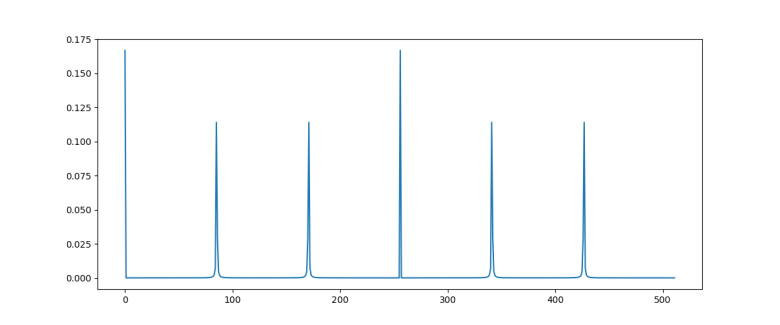
The diagram below plots the probability distribution P(s) for our example, i.e. N = 512 and r = 6 (this plot has been generated using the demo Shor.py available in my GitHub account which uses the numpy package to simulate a run of Shor’s algorithm on a classical computer)
ShorSampleOutput

As expected, we see sharp peaks, located roughly at multiples of 512 / 6 = 85.33. So when we measure the first register, the value s will be close to a multiple of 512 / 6 with a very high probability.

So the quantum algorithm can be summarized as follows.

  • Prepare a superposition \frac{1}{\sqrt{N}} \sum_k |k \rangle |x^k \mod M \rangle
  • Apply the (inverse of the) quantum Fourier transform to this state
  • Measure the value of the first register and call the result s

When running the simulation during which the diagram above was created, I did in fact get a measurement at s = 427 which is very close to 5*512 / 6.

Extracting the period

So having our measurement s = 427 in our hands, how can we use this to determine the period r? We know from the considerations above that s is close to a multiple of N / r, i.e. we know that there is an integer d such that
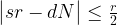
\big| sr - dN \big| \leq \frac{r}{2}

which we can rewrite as

\big| \frac{s}{N} - \frac{d}{r} \big| \leq \frac{1}{2N} < \frac{1}{M^2}

Thus we are given two rational numbers – s / N and d / r – which we know to be very close to each other. We have the first number s / N in our hands and want to determine the second number. We also know that the denominator r of the second number is smaller than M. Is this sufficient to determine d and r?

Surprisingly, the answer is “yes”. We will not go into details at this point and gloss over some of the number theory, but refer the reader to the classical reference [1] or to my notes for more details). The first good news is that two different fractions with denominators less than M need to be at least by 1 / M2 apart, so the number d / r is unique. The situation is indicated in the diagram below.
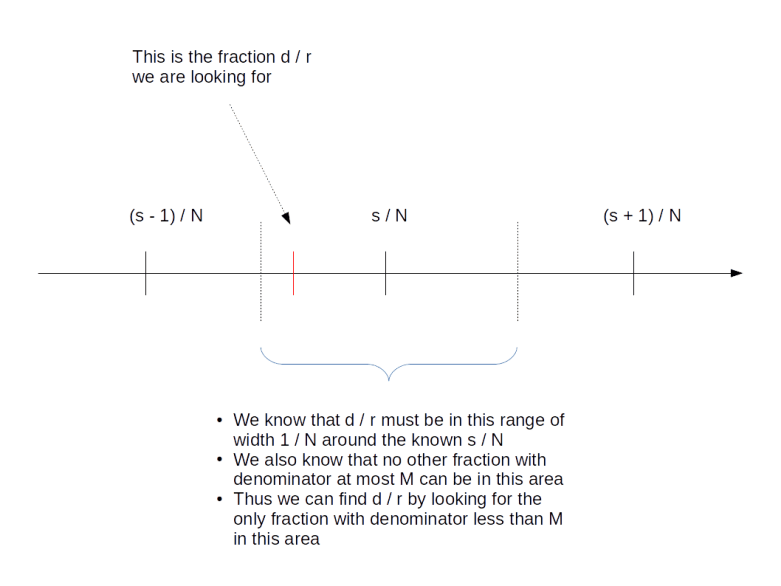
ShorContinuedFraction

But how to find it? Luckily, the theory of continued fractions comes to the rescue. If you are not familiar with continued fractions, you can find out more in the appendix of my notes or on the very good Wikipedia page on this. Here, we will just go through the general procedure using our example at hand.

First, we write

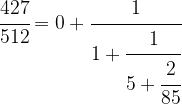
\cfrac{427}{512} = 0 + \cfrac{1}{\cfrac{512}{427}}  = 0 + \cfrac{1}{1 + \cfrac{85}{427}}

We can do the same with 85 / 427, i.e. we can write

\cfrac{85}{427} = \cfrac{1}{\cfrac{427}{85}} =  \cfrac{1}{5 + \cfrac{2}{85}}

which will give us the decomposition

\cfrac{427}{512} = 0 + \cfrac{1}{1 + \cfrac{1}{5 + \cfrac{2}{85}}}

Driving this one step further, we finally obtain
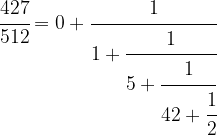
\cfrac{427}{512} = 0 + \cfrac{1}{1 + \cfrac{1}{5 + \cfrac{1}{42 + \cfrac{1}{2}}}}

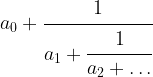
This is called the continued fraction expansion of the rational number 427 / 512. More generally, for every sequence [a_0 ; a_1, a_2, \dots ], we can form the continued fraction

a_0 + \cfrac{1}{a_1 + \cfrac{1}{a_2 + \dots}}

given by that sequence of coefficients, which is obviously a rational number. One can show that in fact every rational number has a representation as a continued fraction, and our calculation has shown that

\cfrac{427}{512} = [0; 1,5,42,2]

This sequence has five coefficients. Now given a number m, we can of course look at the sequence that we obtain by looking at the cofficients up to index m only. For instance, for m = 3, this would give us the sequence

[0; 1,5,42]

The rational number represented by this sequence is

0 + \cfrac{1}{1 + \cfrac{1}{5 + \cfrac{1}{42}}}  = \cfrac{211}{253}

and is called the m-th convergent of the original continued fraction. We have such a convergent for every m, and thus get a (finite) series of rational numbers with the last one being the original number.

One can now show that given any rational number x, the series of m-th convergents of its continued fraction expansion has the following properties.

  • The convergents are in their lowest terms
  • With increasing m, the difference between x and the m-th convergent gets smaller and smaller, i.e. the convergents form an approximation of x that gets better and better
  • The denominators of the convergents are increasing

So the convergents can be used to approximate the rational number x by fractions with smaller denominator – and this is exactly what we need: we wish to approximate the rational number s / N by a ratio d / r with smaller denominator which we then know to be the period. Thus we need to look at the convergents of 427 / 512. These can be easily calculated and turn out to be
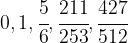
0, 1, \cfrac{5}{6}, \cfrac{211}{253}, \cfrac{427}{512}

The last convergent whose denominator is still smaller than M = 21 is 5 / 6, and thus we obtain r = 6. This is the period that we are looking for!

So in general, the recipe to get from the measured value s to r is to calculate the convergents of the rational number s / N and pick the denominator of the last convergent that has a denominator less than M. Again, if you want to see the exact algorithm, you can take a look at my script Shor.py.

Find the factor

We are almost done. We have run the quantum algorithm to obtain an approximate multiple of N / r. We have then applied the theory of continued fractions to derive the period r of x from this measurement. The last step – which is again a purely classical step – is now to use this to find a factor of M. This is in fact comparatively easy.

Recall that – by definition of the period – we get one if we raise x to the power of r and than reduce module M. In other words, xr minus one is a multiple of M. Now assume that we are lucky and the period r is even. Then

(x^{\frac{r}{2}} - 1)(x^{\frac{r}{2}} + 1) = (x^r - 1) \equiv 0 \mod M

With a bit of elementary number theory, one can now show that this implies that the greatest common divisor gcd(xr/2-1, M) is a factor of M (unless, in fact, xr/2 is minus one modulo M, in which case the argument fails). So to get from the period to a potential factor of M, we simply calculate this greatest common divisor and check whether it divides M!

Let us do this for our case. Our period is r = 6. With x = 11, we have x3 = 1331, which is 8 module M. Thus

\text{gcd}(x^{\frac{r}{2}} - 1 \mod M, M) =  \text{gcd}(7,21) = 7

which is the factor of M = 21 that we were looking for.

Performance of the algorithm

In our derivation, we have ignored a few special cases which can make the algorithm fail. For instance, suppose we had not measured s = 427, but s = 341 after applying the Fourier transform. Then the corresponding approximation to 341 / 512 would have been 4 / 6. However, the continued fraction algorithm always produces a result that is in its lowest terms, i.e. it would give us not 4 / 6, but 2 / 3. Looking at this, we would infer that r = 3, which is not the correct result.

There are a few other things that can go wrong. For instance, we could find a period r which is odd, so that our step to derive a factor of M from r does not work, or we might measure an unlikely value of s.

In all these cases, we need to start over and repeat the algorithm. Fortunately, Shor could show that the probability that any of this happens is bounded from below. This bound is decreasing with larger values of M, but it is decreasing so slowly that the expected number of trials that we need grows at most logarithmically and does not destroy the overall performance of the algorithm.

Taking all these considerations into account and deriving bounds for the number of gates required to perform the quantum part of the algorithm, Shor was able to show that the number of steps to obtain a result grows at most polynomially with the number of bits that the number M has. This is obviously much better than the best classical algorithm that requires a bit less than exponential time to factor M. Thus, assuming that we are able to build a working quantum computer with the required number of gates and qubits, this algorithm would be able to factorize large numbers exponentially faster than any known classical algorithm.

Shor’s algorithm provides an example for a problem that is believed to be in the class NP (but not in P) on a classical computer, but in the class BQP on a quantum computer – this is the class of all problems that can be solved in polynomial time with a finite probability of success. However, even though factorization is generally believed not to be in P, i.e. not doable in polynomial time on classical hardware, there is not proof for that. And, even more important, it is not proved that factorization is NP-complete. Thus, Shor’s algorithm does not render every problem in NP solvable in polynomial time on a quantum computer. It does, however, still imply that all public key cryptography systems like RSA that rely on the assumption that large numbers are difficult to factor become inherently insecure once a large scale reliable quantum computer becomes available.

References

1. G.H. Hardy, E.M. Wright, An introduction to the theory of numbers, Oxford University Press, Oxford, 1975
2. P. Shor, Polynomial-Time Algorithms for Prime Factorization and Discrete Logarithms on a Quantum Computer, SIAM J.Sci.Statist.Comput. Vol. 26 Issue 5 (1997), pp 1484–1509, available as arXiv:quant-ph/9508027v2

Grover’s algorithm – unstructured search with a quantum computer

In the last post, we have looked at the Deutsch-Jozsa algorithm that is considered to be the first example of a quantum algorithm that is structurally more efficient than any classical algorithm can probably be. However, the problem solved by the algorithm is rather special. This does, of course, raise the question whether a similar speed-up can be achieved for problems that are more relevant to practical applications.

In this post, we will discuss an algorithm of this type – Grover’s algorithm. Even though the speed-up provided by this algorithm is rather limited (which is of a certain theoretical interest in its own right), the algorithm is interesting due to its very general nature. Roughly speaking, the algorithm is concerned with an unstructured search. We are given a set of N = 2n elements, labeled by the numbers 0 to 2n-1, exactly one of which having a property denoted by P. We can model this property as a binary valued function P on the set \{0,N-1\} that is zero on all but one elements. The task is to locate the element x0 for which P(x0) is true.

Grover’s algorithm

Grover’s algorithm presented in [1] proceeds as follows to locate this element. First, we again apply the Hadamard-Walsh operator W to the state |0 \rangle of an n-qubit system to obtain a superposition of all basis states. Then, we iteratively apply the following sequence of operations.

  1. Apply a conditional phase shift S, i.e. apply the unique unitary transformation that maps |x \rangle to (-1)^{f(x)} |x \rangle .
  2. Apply the unitary transformation D called diffusion that we will describe below

Finally, after a defined number of outcomes, we perform a measurement which will collaps the system into one of the states |x \rangle . We claim – and will see why this is true below – that for the right number of iterations, this value x will, with a high likelihood, be the solution to our problem, i.e. equal to x0.

Before we can proceed, we need to define the matrix D. This matrix is \frac{2}{N} - 1 along the diagonal, with N = 2n, and \frac{2}{N} away from the diagonal. In terms of basis vectors, the mapping is given by


|i \rangle \mapsto \frac{2}{N} (\sum_j |j \rangle) - |i \rangle

Consequently, we see that

D \sum_i a_i |i \rangle = \sum_i (2 \bar{a} - a_i) |i \rangle

where \bar{a} is the average across the amplitudes a_i . Thus geometrically, the operation D performs an inversion around the average. Grover shows that this operation can be written as minus a Hadamard-Walsh operation followed by the operation that flips the sign for |0 \rangle , followed by a second Hadamard-Walsh transformation.
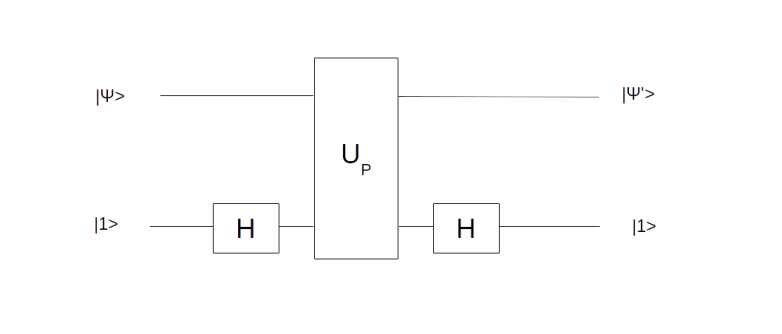
For the sake of completeness, let us also briefly discuss the first transformation employed by the algorithm, the conditional phase shift. We have already seen a similar transformation while studying the Deutsch-Jozsa algorithm. In fact, we have shown in the respective blog post that the circuit displayed below (with the notation slightly changed)

conditionalphaseshifti.png

performs the required operation

|\psi \rangle = \sum_x a_x |x \rangle \mapsto |\psi' \rangle = \sum_x a_x (-1)^{P(x)} |x \rangle

Let us now see how why Grover’s algorithm works. Instead of going through the careful analysis in [1], we will use bar charts to visualize the quantum states (exploiting that all involved matrices are actually real valued).

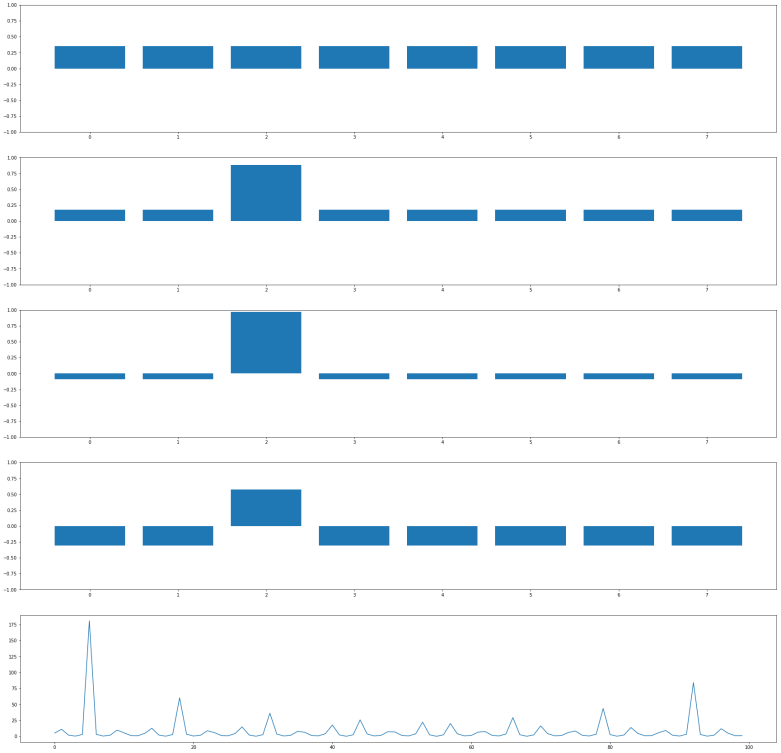
It is not difficult to simulate the transformation in a simple Python notebook, at least for small values of N. This script performs several iterations of the algorithm and prints the result. The diagrams below show the outcome of this test.

Grover

Let us go through the diagrams one by one. The first diagram shows the initial state of the algorithm. I have used 3 qubits, i.e. n = 3 and N = 8. The initial state, after applying the Hadamard-Walsh transform to the zero state, is displayed in the first line. As expected, all amplitudes are equal to 1 over the square root of eight, which is approximately 0.35, i.e. we have a balanced superposition of all states.

We now apply one iteration of the algorithm. First, we apply the conditional phase flip. The element we are looking for is in this case located at x = 2. Thus, the phase flip will leave all basis vectors unchanged except for |2 \rangle and it will change the amplitude of this vector to – 0.35. This will change the average amplitude to a value slightly below 0.35. If we now perform the inversion around the average, the amplitudes of all basis vectors different from |2 \rangle will actually decrease, whereas the amplitude of |2 \rangle will increase. The result is displayed in the second line of the diagram.

Thus, what really happens in this case is an amplitude amplification – we increase the amplitude of one component of the superposition while decreasing all the others.

The next few lines show the result of repeating these two steps. We see that after the second iteration, almost all of the amplitude is concentrated on the vector |2 \rangle , which represents the solution we are looking for. If we now perform a measurement, the result will be 2 with a very high probability!

It is interesting to see that when we perform one more iteration, the difference between the amplitude of the solution and the amplitudes of all other components decreases again. Thus the correct choice for the number of iterations is critical to make the algorithm work. In the last line, we have plotted the difference between the amplitude of |2 \rangle and the other amplitudes (more precisely, the ratio between the amplitude of |2 \rangle and the second largest amplitude) on the y-axis for the different number of iterations on the x-axis. We see that the optimal number of iterations is significantly below 10 (actually five iterations give the best result in this case), and more iterations decrease the likelihood of getting the correct result out of the measurement again. In fact, a careful analysis carried out in [2] shows that for large values of N, the best number of iterations is given by \frac{\pi}{4} \sqrt{N} , and that doubling the number of iterations does in general lead to a less optimal result.

Generalizations and amplitude amplification

In a later paper ([3]), Grover describes a more general setup which is helpful to understand the basic reason why the algorithm works – the amplitude amplification. In this paper, Grover argues that given any unitary transformation U and a target state (in our case, the state representing the solution to the search problem), the probability to meet the target state by applying U to a given initial state can be amplified by a sequence of operations very much to the one considered above. We will not go into details, but present a graphical representation of the algorithm.

So suppose that we are given an n-qubit quantum system and two basis vectors – the vector t representing the target state and an initial state s. In addition, assume we are given a unitary transformation U. The goal is to reach t from s by subsequently applying U itself and a small number of additional gates.

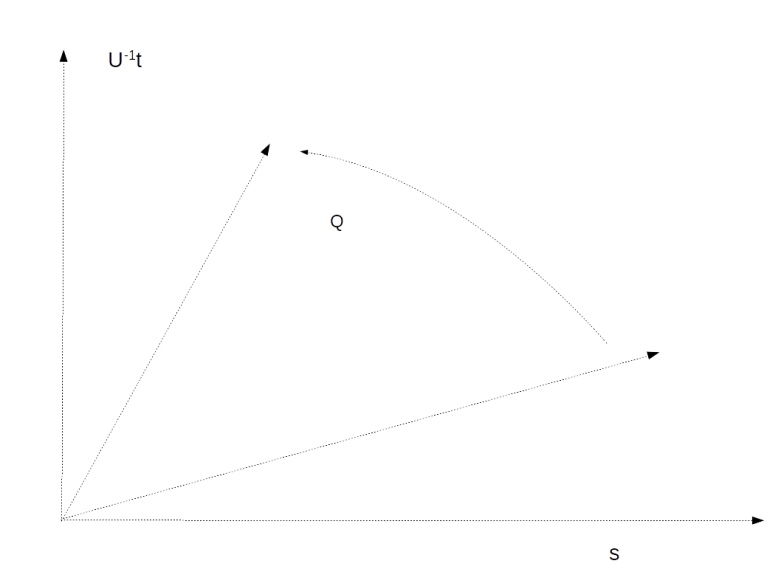
Grover considers the two-dimensional subspace spanned by the vectors s and U-1t. If, within this subspace, we ever manage to reach U-1t, then of course one more application of U will move us into the desired target state.

Now let us consider the transformation

Q = - I_s U^{-1} I_t U

where Ix denotes a conditional phase shift that flips the phase on the vector |x \rangle . Grover shows that this transformation does in fact leave our two-dimensional subspace invariant, as indicated in the diagram below.

AmplitudeAmplification

He then proceeds to show that for sufficiently small values of the matrix element Uts, the action of Q on this subspace can approximately be described as a rotation by the angle \frac{2}{|U_{ts}|} . Applying the operation Q n times will then approximately result in a superposition of the form

\cos (\frac{2n}{|U_{ts}|})|s \rangle + a U^{-1}|t \rangle

Thus if we can make the first coefficient very small, i.e. if \frac{4n}{|U_{ts}|} is close to a multiple of \pi , then one application of U will take our state to a state very close to t.

Let us link this description to the version of the Grover algorithm discussed above. In this version, the initial state s is the state |0 \rangle . The transformation U is the Hadamard-Walsh transformation W. The target state is |x_0 \rangle where x0 is the solution to the search problem. Thus the operation It is the conditional phase shift that we have denoted by S earlier. In addition, Grover shows in [1] already that the diffusion operator D can be expressed as -W I0 W. Now suppose we apply the transformation Q n times to the initial state and then apply U = W once more. Then our state will be

W Q \dots Q |0 \rangle

This can be written as

W (-I_0 W S W) (-I_0 W S W) \dots (-I_0 W S W) |0 \rangle

Regrouping this and using the relation D = -W I0 W, we see that this is the same as

- (W I_0 W) S (- W I_0 W) S \dots  \dots (- W I_0 W) S W |0 \rangle  = D S \dots D S W |0 \rangle

Thus the algorithm can equally well be described as applying W once to obtain a balanced superposition and then applying the sequence DS n times, which is the formulation of the algorithm used above. As |U_{ts} | = \frac{1}{\sqrt{N}} in this case, we also recover the result that the optimal number of iterations is \frac{\pi}{4} \sqrt{N} for large N.

Applications

Grover’s algorithm is highly relevant for theoretical reasons – it applies to a very generic problem and (see the discussions in [1] and [2]) is optimal, in the sense that it provides a quadratic speedup compared to the best classical algorithm that requires O(N) operations, and that this cannot be improved further. Thus Grover’s algorithm provides an interesting example for a problem where a quantum algorithm delivers a significant speedup, but no exponential speedup as we will see it later for Shor’s algorithm.

However, as discussed in detail in section 9.6 of [4], the relevance of the algorithm for practical applications is limited. First, the algorithm applies to an unstructured search, i.e. a search over unstructured data. In most practical applications, we deal with databases that have some sort of structure, and then more efficient search algorithms are known. Second, we have seen that the algorithm requires O(\sqrt{N}) applications of the transformation UP. Whether this is better than the classical algorithm does of course depend on the efficiency with which we can implement this with quantum gates. If applying UP requires O(N) operations, the advantage of the algorithm is lost. Thus the algorithm only provides a significant speedup if the operation UP can be implemented efficiently and there is no additional structure that a classical algorithm could exploit.

Examples of such problems are brute forces searches as they appear in some crypto-systems. Suppose for instance we are trying to break a message that is encrypted with a symmetric key K, and suppose that we know the first few characters of the original text. We could then try to use an unstructured search over the space of all keys to find a key which matches at least the few characters that we know.

In [5], a more detailed analysis of the complexity in terms of qubits and gates that a quantum computer would have to attack AES-256 is made, arriving at a size of a few thousand logical quantum bits. Given the current ambition level, this does not appear to be completely out of reach. It does, however, not render AES completely unsecure. In fact, as Grover’s algorithm essentially results in a quadratic speedup, a code with a key length of n bits in a pre-quantum world is essentially as secure as the same code with a key length of 2n in a post-quantum world, i.e. roughly speaking, doubling the key length compensates the advantage of quantum computing in this case. This is the reason why the NIST report on post-quantum cryptography still classifies AES as inherently secure assuming increased key sizes.

In addition, the feasibility of a quantum algorithm is not only determined by the number of qubits required, but also by other factors like the depth, i.e. the number of operations required, and the number of quantum gates – and for AES, the estimates in [5] are significant, for instance a depth of more than 2145 for AES-256, which is roughly 1043. Even if we assume a switching time of only 10-12 seconds, we still would require astronomical 1031 seconds, i.e. in the order of 1023 years, to run the algorithm.

Even a much less sophisticated analysis nicely demonstrates the problem behind these numbers – the number of iterations required. Suppose we are dealing with a key length of n bits. Then we know that the algorithm requires

\frac{\pi}{4} \sqrt{2^n} \approx 0.8 \sqrt{2}^n

iterations. Taking the decimal logarithm, we see that this is in the order of 100.15*n. Thus, for n = 256, we need in the order of 1038 iterations – a number that makes it obvious that AES-256 can still be considered secure for all practical purposes.

So overall, there is no reason to be overly concerned about serious attacks to AES with sufficiently large keys in the near future. For asymmetric keys, however, we will soon see that the situation is completely different – algorithms like RSA or Elliptic curve cryptography are once and for all broken as soon as large-scale usable quantum computer become reality. This is a consequence of Shor’s algorithm that we will study soon. But first, we need some more preliminaries that we will discuss in the next post, namely quantum Fourier transforms.

References

1. L.K. Grover, A fast quantum mechanical algorithm for database search, Proceedings, 28th Annual ACM Symposium on the Theory of Computing (STOC), May 1996, pages 212-219, available as arXiv:quant-ph/9605043v3
[2] M. Boyer, G. Brassard, P. Høyer, A. Tapp, Tight bounds on quantum searching, arXiv:quant-ph/9605034
3. L.K. Grover, A framework for fast quantum mechanical algorithms, arXiv:quant-ph/9711043
4. E. Rieffel, W. Polak, Quantum computing – a gentle introduction, MIT Press
5. M. Grassl, B. Langenberg, M. Roetteler, R. Steinwandt, Applying Grover’s algorithm to AES: quantum resource estimates, arXiv:1512.04965

More on Paperspace Gradient

Its been a few days since I started to play with Paperspace, and I have come across a couple of interesting features that the platform has – enough for a second post on this topic.

First, GIT integration. Recall that the usual process is to zip the current working directory and submit the resulting file along with the job, the ZIP file is then unzipped in the container in which the job is running and the contents of the ZIP file constitute the working directory. However, if you want to run code that requires, for instance, custom libraries, it is much easier to instruct Paperspace to get the contents of the working directory from GitHub. You can do that by supplying a GIT URL using the --workspace switch. The example below, for instance, instructs Paperspace to pull my code for an RBM from GitHub and to run it as a job.

#!/bin/sh
#
# Run the RBM as a job on Paperspace. Assume that you have the paperspace NodeJS
# CLI and have done a paperspace login before to store your credentials
#
#
~/node_modules/.bin/paperspace jobs create  \
        --workspace "git+https://github.com/christianb93/MachineLearning" \
        --command "export MPLBACKEND=AGG ; python3 RBM.py \
        --N=28 --data=MNIST \
        --save=1 \
        --tmpdir=/artifacts \
        --hidden=128 \
        --pattern=256 --batch_size=128 \
        --epochs=40000 \
        --run_samples=1 \
        --sample_size=6,6 \
        --beta=1.0 --sample=200000 \
        --algorithm=PCDTF --precision=32" \
        --machineType K80 \
        --container "paperspace/tensorflow-python" \
        --project "MachineLearning"

Be careful, the spelling of the URL must be exactly like this to be recognized as a GIT URL, i.e. “git+https” followed by the hostname without the “www”, if you use http instead of https or http://www.github.com instead of github.com, the job will fail (the documentation at this point could be better, and I have even had to look at the source code of the CLI to figure out the syntax). This is a nice feature, using that along with the job logs, I can easily reconstruct which version of the code has actually been executed, and it supports working in a team that is sharing GitHub repositories well.

Quite recently, Paperspace did apparently also add the option to use persistent storage in jobs to store data across job runs (see this announcement). Theoretically, the storage should be shared between notebooks and jobs in the same region, but as I have not yet found out how to start a notebook in a specific region, I could not try this out.

Another feature that I liked is that the container that you specify can actually be any container from the Docker Hub, for instance ubuntu. The only restriction is that Paperspace seems to overwrite the entrypoint in any case and will try to run bashinside the container to finally execute the command that you provide, so containers that do not have a bash in the standard execution path will not work. Still, you could use this to prepare your own containers, maybe with pre-installed data sets or libraries, and ask Paperspace to run them.

Finally, for those of us who are Python addicts, there is also a Python API for submitting and managing jobs in Paperspace. Actually, this API offers you two ways to run a Python script on Paperspace. First, you can import the paperspace package into your script and then, inside the script, do a paperspace.run(), as in the following example.

import paperspace
paperspace.run()
print('This will only be running on Paperspace')

What will happen behind the scenes is that the paperspace module takes your code, removes any occurrences of the paperspace package itself, puts the code into a temporary file and submits that as a job to Paperspace. You can then work with that job as with any other job, like monitoring it on the console or via the CLI.

That is nice and easy, but not everyone likes to hardcode the execution environment into the code. Fortunately, you can also simply import the paperspace package and use it to submit an arbitrary job, much like the NodeJs based CLI can do it. The code below demonstrates how to create a job using the Python API and download the output automatically (this script can also be found on GitHub).

import paperspace.jobs
from paperspace.login import apikey
import paperspace.config

import requests


#
# Define parameters
#
params = {}
# 
# We want to use GIT, so we use the parameter workspaceFileName
# instead of workspace
#
params['workspaceFileName'] = "git+https://github.com/christianb93/MachineLearning"
params['machineType'] = "K80"
params['command'] = "export MPLBACKEND=AGG ; python3 RBM.py \
                --N=28 --data=MNIST \
                --save=1 \
                --tmpdir=/artifacts \
                --hidden=128 \
                --pattern=256 --batch_size=128 \
                --epochs=40000 \
                --run_samples=1 \
                --sample_size=6,6 \
                --beta=1.0 --sample=200000 \
                --algorithm=PCDTF --precision=32"
params['container'] = 'paperspace/tensorflow-python'
params['project'] = "MachineLearning"
params['dest'] = "/tmp"

#
# Get API key
#
apiKey = apikey()
print("Using API key ", apiKey)
#
# Create the job. We do NOT use the create method as it cannot
# handle the GIT feature, but assemble the request ourselves
#
http_method = 'POST'
path = '/' + 'jobs' + '/' + 'createJob'


r = requests.request(http_method, paperspace.config.CONFIG_HOST + path,
                             headers={'x-api-key': apiKey},
                             params=params, files={})
job = r.json()
    
if 'id' not in job:
    print("Error, could not get jobId")
    print(job)
    exit(1)

jobId = job['id']
print("Started job with jobId ", jobId)
params['jobId']  = jobId

#
# Now poll until the job is complete

if job['state'] == 'Pending':
    print('Waiting for job to run...')
    job = paperspace.jobs.waitfor({'jobId': jobId, 'state': 'Running'})

print("Job is now running")
print("Use the following command to observe its logs: ~/node_modules/.bin/paperspace jobs logs --jobId ", jobId, "--tail")

job = paperspace.jobs.waitfor({'jobId': jobId, 'state': 'Stopped'})
print("Job is complete: ", job)

#
# Finally get artifacts
#
print("Downloading artifacts to directory ", params['dest'])
paperspace.jobs.artifactsGet(params)

There are some additional features that the Python API seems to have that I have not yet tried out. First, you can apparently specify an init script that will be run before the command that you provide (though the use of that is limited, as you could put this into your command as well). Second, and more important, you can provide a requirements file according to the pip standard to ask Paperspace to install any libraries that are not available in the container before running your command.

Overall, my impression is that these APIs make it comparatively easy to work with jobs on Paperspace. You can submit jobs, monitor them and get their outputs, and you enjoy the benefit that you are only billed for the actual duration of the job. So if you are interested in a job based execution environment for your Machine Learning models, it is definitely worth a try, even though it takes some time to get familiar with the environment.

The EM algorithm and Gaussian mixture models – part II

In this post, I will discuss the general form of the EM algorithm to obtain a maximum likelihood estimator for a model with latent variables.

First, let us describe our model. We suppose that we are given some joint distribution of a random variable X (the observed variables) and and random variable Z (the latent variables) and are interested in maximizing the likelihood of an observed sample x of the visible variable X. We also assume that the joint distribution depends on a parameter \Theta, in practice this could be weights, bias terms or any other parameters. To simplify things a bit, we will also assume that the latent variable is finite. Our aim is to maximize the log likelihood, which we can – under these assumptions – express as follows.

\ln P(x |\Theta) = \ln \sum_z P(x,z | \Theta)

Even if the joint distribution belongs to some exponential family, the fact that we need to consider the logarithm of the sum and not the sum of the logarithms makes this expression and its gradient difficult to calculate. So let us look for a different approach.

To do this, let us assume that we are given a value \Theta of the parameter and let us try to understand how the likelihood changes if we pass from \Theta to some other value \Theta'. For that purpose, we introduce a term that is traditionally called Q and defined as follows (all this is a bit abstract, but will become clearer later when we do an example):

Q(\Theta'; \Theta) = E \left[  \ln P(x,z | \Theta')  | x, \Theta \right]

That looks a bit complicated, so let me explain the notation a bit. We want to define a function Q that will be a function of the new parameter value \Theta'. This function will, in addition, depend on the current value \Theta which we consider as a parameter.

The right hand side is an expectation value. In fact, for each value of the visible variable x and the parameter \Theta, we have a probability distribution on the space in which Z lives, given by the conditional probability of Z given x and \Theta. Whenever we have a function depending on z, we can therefore form the expectation value as usual, i.e. as the weighted sum over all function values, weighted by the probability of z. In particular, we can do this for the function \ln P(x,z | \Theta') of z. Thus the right hand side is, spelled out

E \left[  \ln P(x,z | \Theta')  | x, \Theta \right] = \sum_z \ln P(x,z | \Theta') P(z | x, \Theta)

That is now again a sum of logarithms, not a logarithm of a sum, and we can hope to be able to deal with this much better.

This is nice, but so far we have only introduced a rather complicated additional object – what do we gain? It turns out that essentially, maxizing Q will effectively maximize the likelihood. Let us make this bold statement a bit more precise. Suppose we are able to iteratively maximize Q. Expressed formally, this would mean that we are able to find a sequence \Theta^0, \Theta^1, \dots of parameters such that when passing from \Theta^t to \Theta^{t+1}, the value of Q does not decrease, i.e.


Q(\Theta^{(t+1)};\Theta^{(t)}) \geq Q(\Theta^{(t)} ; \Theta^{(t)})

Then this very same sequence will be a sequence of parameters for which the log-likelihood is non-decreasing as well, i.e.

\ln P(x | \Theta^{(t+1)}) \geq \ln P(x | \Theta^{(t)})

I will not include a proof for this in this post (the proof identifies the difference between any two subsequent steps as a Kullback-Leibler divergence and makes use of the fact that a Kullback-Leibler divergence is never negative, you can find a a proof in the references, in particular in [2], or in my more detailed notes on the EM algorithm and Gaussian mixture models, where I also briefly touch on convergence). Instead, let us try to understand how this can be used in practice.

Suppose that we have already constructed some parameter \Theta^t. The algorithm then proceeds in two steps. First, we calculate Q as a function of the new parameter \Theta^{t+1}. As Q is defined as an expectation value, this step is called the expectation step. Once we have that, we try to maximize Q, i.e. we try to find a value for the parameter \Theta^{t+1} such that Q(\Theta^{t+1}; \Theta^t) is maximized. This part of the algorithm is therefore called the maximization step. Then we start over, using \Theta^{t+1} as new starting point. Thus the algorithm alternates between an expectation and a maximization step, leading to the name EM algorithm.

To see how this works in practice, let us now return to our original example – Gaussian mixtures. Here the parameter \Theta is given by

\Theta = (\mu, \pi, \Sigma)

We consider a random variable X which has N components, each of which being a vector Xn in a d-dimensional space and corresponding to one sample vector (so in the language of machine learning, N will be our batch size). Similarly, Z consists of N components zn which again are subject to the restriction that only one of the znk be different from zero. We assume that the joint representation of our model is given by

P(x , z) = \prod_n \prod_k \pi_k^{z_{nk}}{\mathcal N} (x_n, \mu_k , \Sigma_k)^{z_{nk}}

Now we need to compute Q. The calculation is a bit lengthy, and I will skip most of it here (you can find the details in the references or my notes for this post). To state the result, we have to introduce a quantity called responsibility which is defined as follows.

r_{nk} = \frac{\pi_k {\mathcal N}(x_n ; \mu_k, \Sigma_k)} {\sum_{j} \pi_j {\mathcal N}(x_n ; \mu_j, \Sigma_j) }

From this definition, is it clear that the responsibility is always between zero and one, and in fact is has an interpretation of a (conditional) probability that sample n belongs to cluster k. Note that the responsibility is a function of the model parameters \mu, \pi and \Sigma. Using this notation, we can now write down the result of calculating the Q function:

Q(\Theta'; \Theta) = \sum_n \sum_k r_{nk} \ln \pi'_k + \sum_n \sum_k r_{nk} \ln {\mathcal N}(x ; \mu'_k, \Sigma'_k)

where the responsibilities are calculated using the old parameter set \Theta = (\mu, \pi, \Sigma). For a fixed \Theta, this is a function of the new parameters \mu', \pi' and \Sigma', and we can now try to maximize this function with respect to these parameters. This calculation is not difficult, but again a bit tiresome (and requires the use of Lagrangian multipliers as there is a constraint on the \pi_k), and I again refer to my notes for the details. When the dust settles, we obtain three simple expressions. First, the new values for the cluster means are given by

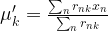
\mu'_k = \frac{\sum_n r_{nk} x_n}{\sum_n r_{nk}}

This starts to look familiar – this is the same expression that we did obtain for the cluster centers for the k-means algorithm! In fact, if we arrange the rnk as a matrix, the denominator is the sum across column k and the numerators is the weighted sum over all data points. However, there is one important difference – it is no longer true that given n, only one of the rnk will be different from one. Instead, the rnk are soft assignments that model the probability that the data point xn belongs to cluster k.

To write down the expression for the new value of the covariance matrix, we again need a notation first. Set

N_k = \sum_n r_{nk}

which can be interpreted as the number of soft assignments of points to cluster k. With that notation, the new value for the covariance matrix is

\Sigma'_k = \frac{1}{N_k} \sum_n r_{nk} (x_n - {\mu'}_k)(x_n - {\mu'}_k)^T

Finally, we can use the method of Lagrange multipliers to maximize with respect to the weights \pi_k (which always need to sum up to one), and again obtain a rather simple expression for the new value.

\pi'_k = \frac{N_k}{N}

Again, this is intuitively very appealing – the probability to be in cluster k is updated to be the number of points with a soft assignment to k divided by the total number of assignments

We now have all the ingredients in place to apply the algorithm in practice. Let us summarize how this will work. First, we start with some initial value for the parameters – the weights \pi, the covariance matrices \Sigma_k and the means \mu_k – which could, for instance, be chosen randomly. Then, we calculate the responsibilities as above – essentially, this is the expectation step, as it amounts to finding Q.

In the M-step, we then use these responsibilities and the formulas above to calculate the new values of the weights, the means and the covariance matrix. This involves a few matrix operations, which can be nicely expressed by the operations provide by the numpy library.

GMM

In the example above, we have created two sets of 500 sample points from different Gaussian mixture distributions and then applied the k-means algorithm and the EM algorithm. In the top row, we see the results of running the k-means algorithm. The color indicates the result of the algorithm, the shape of the marker indicates the original cluster to which the point belongs. The bottom row displays the results of the EM algorithm, using the same pattern.

We see that while the first sample (diagrams on the left) can be clustered equally well by both algorithms, the k-means algorithm is not able to properly cluster the second sample (diagrams on the right), while the EM algorithm is still able to assign most of the points to the correct cluster.

If you want to run this yourself, you can – as always – find the source code on GitHub. When playing with the code and the parameters, you will notice that the results can differ substantially between two consecutive runs, this is due to the random choice of the initial parameters that have a huge impact on convergence (and sometimes the code will even fail because the covariance matrix can become singular, I have not yet fixed this). Using the switch --data=Iris, you can also apply the EM algorithm to the Iris data set (you need to have a copy of the Iris data file in the current working directory) and find again that the results vary significantly with different starting points.

The EM algorithm has the advantage of being very general, and can therefore be applied to a wide range of problems and not just Gaussian mixture models. A nice example is the Baum Welch algorithm for training Hidden Markov models which is actually an instance of the EM algorithm. The EM algorithm can even be applied to classical multi-layer feed forward networks, treating the hidden units as latent variables, see [3] for an overview and some results. So clearly this algorithm should be part of every Data Scientists toolbox.

References

1. C.M. Bishop, Pattern recognition and machine learning, Springer, New York 2006
2. A.P. Dempster, N.M. Laird, D.B. Rubin, Maximum likelihood from incomplete data via the EM-algorithm, Journ. Royal Stat. Soc. Series B. Vol. 39 No. 1 (1977), pp. 1-38
3. Shu-Kay Ng, G.J. McLachlan, Using the EM Algorithm to Train Neural Networks: Misconceptions and a New Algorithm for Multiclass Classification, IEEE Transaction on Neural Networks, Vol. 15, No. 3, May 2004

The EM algorithm and Gaussian mixture models – part I

In the last few posts on machine learning, we have looked in detail at restricted Boltzmann machines. RBMs are a prime example for unsupervised learning – they learn a given distribution and are able to extract features from a data set, without the need to label the data upfront.

However, there are of course many other, by now almost classical, algorithms for unsupervised learning. In this and the following posts, I will explain one of the most commonly applied algorithms in this field, namely the EM algorithm.

As a preparation, let us start with a very fundamental exercise – clustering. So suppose that we are given a data set which we suspect to consist of K clusters. We want to identify these clusters, i.e. to each point in the dataset, we want to assign the number of the cluster to which the point belongs.

More precisely, let us suppose that we are given a set {\mathcal D} = \{ x_i, \dots, x_N\} of points in some euclidian space and a number K of clusters. We want to identify the centre \mu_i of each cluster and then assign the data points xi to some of the \mu_j, namely to the \mu_j which is closest to xi. We can encode the assignment of data points to clusters in a matrix Rij where Rij = 1 if data point xi belongs to cluster j with centre \mu_j. Thus each row of R corresponds to a data point and is non-zero in exactly one column, where it is one. This is known as 1-of-K encoding.

For each value of i, the squared distance of xi to the centre of the cluster to which it is assigned is then given by

\sum_j R_{ij} \| x_i - \mu_j |^2

where we note that only one of the summands is different from zero. Assigning the data points to the clusters and positioning the centre points of the clusters then amounts to minimizing the loss function

l(\mu, R) = \sum_i \sum_j R_{ij} \langle x_i - \mu_j , x_i - \mu_j \rangle

where the brackets denote the usual euclidean scalar product.

Now let us see how we can optimize this function. For a fixed vector \mu of cluster centers, we can easily minimize Rij by assigning each data point to the cluster whose center is closest to xi. Thus we set

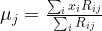
R_{ij} =  \begin{cases} 1 & \text{if} \, j = \arg \min \| x_i - \mu_j \|^2 \\ 0 & \text{otherwise} \end{cases}

Conversely, given a matrix R which we hold fixed, it is likewise easy to minimize \mu_j. As there are no further constraints on \mu_j, we can find the minimum by differentiating the loss function. We find that the derivative is zero if and only if

0 = \sum_i R_{ij}(x_i - \mu_j)

holds for all j. Assuming for a moment that each cluster has at least one data point assigned to it, i.e. that none of the columns of R contains zeroes only, we can solve this by

\mu_j = \frac{\sum_i x_i R_{ij}}{\sum_i R_{ij}}

which is also easily seen to be a local minimum by taking the second derivative.

Note that this term has an obvious geometric interpretation. The denominator in this expression is the number of data points that are currently assigned to cluster j. The numerator is the sum of all data points assigned to this cluster. Thus the minimum is the mean value of the positions of the data points that are currently assigned to the cluster (a physicist would call this the center of gravity of the cluster). This is the reason why this method is called the k-means algorithm. If no data points are assigned to the cluster, the loss function does not depend on \mu_j and we can choose any value that we want.

The algorithm now works as follows. First, we choose centers \mu_j at will – it is common to use some of the data points for this purpose. Then we assign each data point to a center using the formula for Rij derived above. We then adjust the center points \mu_j and reallocate the points to the new centers and so forth.

From our discussion above, it is clear that each full iteration of this procedure will reduce the loss function. This does of course not imply that the algorithm converges to a global minimum, as it might get stuck in local minima or saddle points. In practice, the algorithm is executed until the cluster assignments and centers do not change any more substantially or for a given number of steps.

KMeans

The diagram above shows the result of applying this algorithm to a set of points that is organized in two clusters. To generate the data, 100 samples were drawn from 2-dimensional Gaussian distributions. On the left hand side, half of the the samples were centered at the point (5,1), the other samples at (1,4), and both had standard deviation 0.6. On the right hand side, the same centers were used, but only a small number of samples were drawn from the second distribution which had standard deviation 0.5, whereas most samples came from the first distribution with standard deviation 0.8. Then 10 iterations of the k-means algorithm were applied to the resulting sample set. The points in the sample were then plotted with a color indicating the assignment to clusters resulting from the matrix R. The actual cluster from which the sample was drawn is indicated by the shape – a point is cluster one, a diamond is cluster two.

We see that in the example on the left hand side, the algorithm has correctly assigned all points to their original cluster. For the example on the right hand side, the situation is different – the algorithm did actually assign significantly more points to the blue cluster, i.e. there are many wrong assignments (blue points). This does not change substantially if we increase the number of iterations, even with 100 iterations, we still see many wrong assigments for this example. If you want to reproduce the example and play a bit with the parameters, you can get the sourcecode for a straightforward implementation in Python from my GitHub repository.

The K-means algorithm is very simple and straightforward, but seems to have limitations because it cannot determine the shape of a distribution, only its center. It turns out that K-means is a special case of a broader class of algorithms that we now study, hoping to find more robust algorithms.

In our example, we have generated sample data as a combination of two Gaussian distributions. What if we just change the game and simply assume that our data is of this type? In other words, we assume an underlying probabilistic model for our sample data. Once we have that, we can pull all the tricks that statistical inference can offer – we can calculate maximum likelihood and maximum posterior probability, we can try to determine the posterior or even sample from the model.

Thus let us try to fit our data to a model of the form

P(x) = \sum_k \pi_k {\mathcal N}(x ; \mu_k, \Sigma_k)

where {\mathcal N}(x ; \mu_k, \Sigma_k) is a multivariate Gaussian distribution with mean \mu_k and covariance matrix \Sigma_k, i.e.

{\mathcal N}(x ; \mu_k, \Sigma_k) = \frac{1}{\sqrt{(2\pi)^d \det(\Sigma)}} \exp (-\frac{1}{2} \langle x - \mu_k, \Sigma_k^{-1}(x - \mu_k)\rangle)

and the \pi_k are non-negative real numbers with \sum_k \pi_k = 1.

Let us now see how this equation looks like if we use a 1-of-K encoding. We introduce a random variable Z that takes values in \{ 0, 1\}^K with the additional constraint that only one of the Zk is allowed to be different from zero. We interpret \pi_k as the probability

\pi_k = P(Z_k = 1)

Then

P(Z = z) = \prod_k \pi_k ^{z_k}

and we can write

P(X=x) = \sum_z P(Z=z) P(X=x | Z=z) = \sum_z P(x,z)

where P(z) is as above and

P(X = x | Z = z) = \prod_k {\mathcal N}(x ; \mu_k, \Sigma_k)^{z_k}

This is a very general type of distribution which reflects a common pattern in machine learning, namely the introduction of so called latent or hidden variables. In general, latent or hidden variables are random variables that are a part of the model which cannot be observed, i.e. are not part of the input or the output of the model. We have seen latent variables in action several times – adding hidden units to a neural network introduces latent variables and makes the model much more powerful, the hidden layer of a restricted Boltzmann machine serves as memory to learn features, and latent variables that are used to construct a mixture of Gaussians as above allow us to model a much broader class of distributions than a model with just one Gaussian.

Intuitively, it is also clear how to sample from such a model. In a first step, we sample from Z, in other words we determine the index k randomly according to the distribution given by the \pi_k. Once we have k, we then sample from the conditional distribution P(X = x | Z = z). As we already have k, this amounts to sampling from the Gaussian distribution {\mathcal N}(x ; \mu_k, \Sigma_k) with mean \mu_k and covariance matrix \Sigma_k.
GaussianMixture

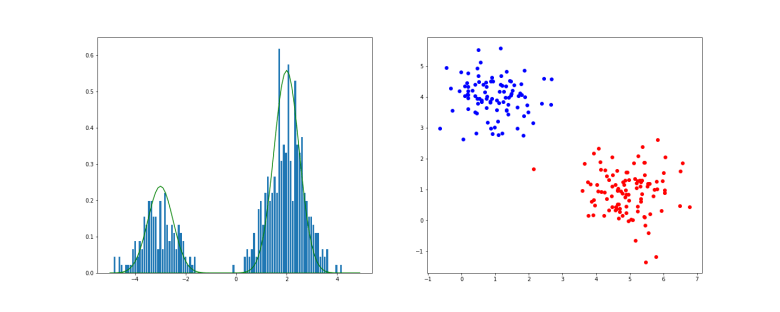
In the example above, we have first applied this procedure to a one-dimensional Gaussian mixture with K=2. The histogram shows the result of the sampling procedure, the solid lines are the probability density functions of the two individual Gaussian distributions, multiplied by the respective weight. On the right hand side, the result of sampling a Gaussian mixture in two dimensions is displayed (you can download the notebook used to produce this example here).

When we now try to fit this model to the sample data, we again have to calculate the likelihood function and try to maximize it. However, it turns out that the gradient of the likelihood is not so easy to calculate, and it might very well be that there is no closed form solution or that we obtain rather complicated expressions for the gradient. Fortunately, there is an alternative that works for very general models and does not require knowledge of the gradient – the EM algorithm. In the next post, I will present the algorithm in this general setup, before we apply it to our original problem and compare the results with the k-means algorithm.

References

1. C.M. Bishop, Pattern recognition and machine learning, Springer, New York 2006
2. A.P. Dempster, N.M. Laird, D.B. Rubin, Maximum likelihood from incomplete data via the EM-algorithm, Journ. Royal Stat. Soc. Series B. Vol. 39 No. 1 (1977), pp. 1-38

Controlling Docker container with Python

In the last few posts on the bitcoin blockchain, I have already extensively used Docker container to quickly set up test environments. However, it turned out to be a bit tiresome to run the containers, attach to them, execute commands etc. to get into a defined state. Time to learn how this can be automated easily using our beloved Python – thanks to the wonderful Docker Python SDK.

This package uses the Docker REST API and offers an intuitive object model to represent container, images, networks and so on. The API can be made available via a TCP port in the Docker configuration, but be very careful if you do this – everybody who has access to that port will have full control over your Docker engine. Fortunately, the Python package can also connect via the standard Unix domain socker on the file system which is not exposed to the outside world.

As always, you need to install the package first using

$ pip install docker

Let us now go through some objects and methods in the API one by one. At the end of the post, I will show how you a complete Python notebook that orchestrates the bitcoind container that we have used in our tests in the bitcoin series.

The first object we have to discuss is the client. Essentially, a client encapsulates a connection to the Docker engine. Creating a client with the default configuration is very easy.

import docker
client = docker.client.from_env()

The client object has only very few methods like client.info() or client.version() that return global status information. The more interesting part of this object are the collections attached to it. Let us start with images, which can be accessed via client.images. To retrieve a specific instance, we can use client.images.list(), passing as an argument a name or a filter. For instance, when we know that there is exactly one image called “alice:latest”, we can get a reference to it as follows.

alice = client.images.list("alice:latest")[0]

Other commands, like pull or push, are the equivalents of the corresponding docker CLI commands.

Let us now turn to the client.containers collection. Maybe the most important method that this collection offers is the run method. For instance, to run a container and capture its output, use

output = client.containers.run("alpine", "ls", auto_remove=True)

This will run a container based on the alpine image and pass “ls” as an argument (which will effectively execute ls as alpine container will run a shell for you) and return the output as a sequence of bytes. The container will be removed after execution is complete.

By setting detach=True, the container will run in detached mode and the call will return immediately. In this case, the returned object is not the output, but a reference to the created container which you can use later to work with the container. If, for instance, you wanted to start an instance of the alice container, you could do that using

alice = client.containers.run("alice:latest", auto_remove=True, detach=True)

You could then use the returned handle to inspect the logs (alice.logs()), to commit, to exec code in the container similar to the docker exec command (alice.exec_run) and so forth.

To demonstrate the possibilities that you have, let us look at an example. The following notebook will start two instances (alice, bob) of the bitcoin-alpine image that you hopefully have build when you have followed my series on bitcoin. It then uses the collection client.networks to figure out to which IP address on the bridge network bob is connected. Then, we attach to the alice container and run bitcoin-cli in this container to instruct the bitcoind to connect to the instance running in container bob.

We then use the bitcoin-cli running inside the container alice to move the blockchain into a defined state – we mine a few blocks, import a known private key into the wallet, transfer a certain amount to a defined address and mine a few additional blocks to confirm the transfer. Here is the notebook.

Loading
Sorry, something went wrong. Reload?
Sorry, we cannot display this file.
Sorry, this file is invalid so it cannot be displayed.

Make sure to stop all containers again when you are done, it is comparatively easy to produce a large number of stopped containers if you are not careful and use this for automated tests. I usually run the container with the --rm flag on the command line or the auto_remove=True flag in Python to make sure that they are removed by the Docker engine automatically when they stop.

Of course nobody would use this to simply run a few docker containers with a defined network setup, there are much better tools like Docker Swarm or other container management solutions for this. However, the advantage of using the Python SDK is that we can interact with the containers, run commands, perform tests etc. And all this can be integrated nicely into integration tests using test fixtures, for instance those provided by pytest. A fixture could bring up the environment, could be defined on module level or test level depending on the context, and can add a finalizer to shut down the environment again after the test has been executed. This allows for a very flexible test setup and offers a wide range of options for automated testing.

This post could only give a very brief introduction into the Python Docker SDK and we will not at all discuss pytest and fixtures – but I invite you to browse the Docker SDK documentation and pytest fixtures and hope you enjoy to play with this!

How the number of bitcoins is limited

In some of the previous posts, we did already hit upon the file chainparams.cpp in the source code of the bitcoin reference client. It is interesting to go through this and understand the meaning of the various parameters defined there. One of them should catch your attention:

class CMainParams : public CChainParams {
public:
    CMainParams() {
        strNetworkID = "main";
        consensus.nSubsidyHalvingInterval = 210000;

What does this parameter mean? It is in fact not used awfully often, apart from some unit tests I could only locate it once, namely in validation.cpp.

CAmount GetBlockSubsidy(int nHeight, const Consensus::Params& consensusParams)
{
    int halvings = nHeight / consensusParams.nSubsidyHalvingInterval;
    // Force block reward to zero when right shift is undefined.
    if (halvings >= 64)
        return 0;

    CAmount nSubsidy = 50 * COIN;
    // Subsidy is cut in half every 210,000 blocks which will occur approximately every 4 years.
    nSubsidy >>= halvings;
    return nSubsidy;
}

The output of this function plays an important role when a new block is mined by mine.cpp – this is the amount (in Satoshis) that a miner earns in addition to the fees! Put differently, this is the amount of bitcoins that are created when a block is mined.

What this code tells us is that the amount of bitcoin added during mining starts with 50 and is divided by two every 210.000 blocks. So the amount of bitcoins mined is a given by the formula

210000 \cdot 50 + 210000 \cdot 25 + 210000 \cdot 12.5 + \dots = \sum_{n=0}^\infty  210000 \cdot 50 \cdot  \frac{1}{2}^n

The mathematicians among us will recognize this as a geometric series

210000 \cdot 50 \cdot \sum_{n=0}^\infty q^n

with q = 0.5. This series converges, and its value is

210000 \cdot 50 \cdot 2 = 21 \cdot 10^{6}

Therefore the amount of bitcoins that are created by mining – and thus the overall supply of bitcoins –  can never exceed roughly 21 million bitcoins. You might have heard that before: bitcoins are by designed with a controlled supply which is guaranteed by the continuous reduction of the subsidity as the number of blocks increases (and not because the value of a bitcoin transaction is stored in a 64 bit integer – in fact this would explain why the value of a single transaction output cannot exceed a certain value, but not why the total sum of all ever issued bitcoins is limited). This is the point in the source code that is responsible for this.

Of course I am cheating a bit – the value of a bitcoin is discrete, not a real number. Mining will stop if the value of the block subsidity falls below one Satoshi, as this is the smallest number that can be represented. Let us see when this happens. The subsidity is given by the formula

s = \frac{5 \cdot 10^{9}}{2^n}

where n is obtained by dividing the block height (i.e. length of the chain) by 210000 and converting to an integer. Solving s = 1 for n, we obtain

n = \log_2 (5 \cdot 10^{9}) \approx 32.2

Therefore the bitcoin amount created with a block will drop to zero with block

m = 210000 * 33 = 6.930.000  .

The total number of bitcoins created until then can be approximated (ignoring rounding) by the partial sum

210000 \cdot 50 \cdot \sum_{n=0}^{32} q^n = \frac{50 \cdot 10^{9}(1 - q^{33})}{1 - q}

which gives 20999999.997 bitcoins, i.e. almost exactly 21 million bitcoins as expected. We can also estimate when this will have happened. Looking at blockchain.info, we see that at the time of writing, approximately 513.000 blocks have already been mined. So we still need 6.418.000 blocks. A block is generated roughly every 10 minutes, so there are 6 additional blocks per hour and therefore 52560 blocks being added per year. Thus it will take roughly 122 years from now until all these blocks have been mined, i.e. this will happen somewhere around the year 2140. So still some time to go until then…

If you do not trust the math, you could also simulate this in a little Python program. In fact, this will give you a bit less than what we have calculated above, as the subsidity is rounded to an integer during the calculation, which our geometric series above does not properly reflect.

COIN = 10**8
nHeight = 0
btc = 0.0
while True:
    halvings = nHeight // 210000
    subsidity = (50*COIN) >> halvings
    btc += subsidity
    if subsidity < 1:
        break
    nHeight += 1

print("Total bitcoin amount: ", btc / 10**8 )

You can also easily determine how many bitcoin are available at each point in time. At 513.000 blocks, these are roughly 16.9 million BTC, which, at a price of 10.000 USD, is equivalent to a market capitalization of roughly 160 billion USD.

Mining bitcoins with Python

In this post, we will learn to build a very simple miner in Python. Of course this miner will be comparatively slow and limited and only be useful in our test network, but it will hopefully help to explain the principles behind mining.

When we want to mine a block, we first need some information on the current state of the blockchain, like the hash of the current last block, the current value of the difficulty or the coin base value, i.e. the number of BTC that we earn when mining the block. When we are done building the block, we need to find a way to submit it into the bitcoin network so that it is accepted by all nodes and permanently added to the chain.

If we were member of a mining pool, there would be a mining server that would provide us the required information. As we want to build a solo mining script, we need to communicate with bitcoin core to get that information and to submit our final block. Fortunately, the RPC interface of bitcoin core offers methods to facilitate that communication that were introduced with BIP22.

First, there is the method getblocktemplate. It will deliver all the required information that we need to build a valid block and even propose transactions that we should include in the block. These transactions will be taken from the so called mempool which is a collection of transactions that the bitcoin server knows which have not been added to a block yet (see miner.cpp/BlockAssembler::addPackageTxs in the bitcoin core source code for details on how the selection process works).

If the client is done building the block, it can submit the final block using the method submitblock. This method will run a couple of checks on the block, for instance that it can be correctly decoded, that the first transaction – and only the first – is a coinbase transaction, that it is not a duplicate and that the proof-of-work is valid. If all the checks pass, it will add the block to the local copy of the blockchain. If a check fails, it will return a corresponding error code to the caller.

With that understanding, let us now write down the processing logic for our simple miner, assuming that we only want to mine one additional block. First, we will use getblocktemplate to get the basic parameters that we need and transaction that we can include. Then we will create a new block and a new coinbase transaction. We then add the coinbase transaction followed by all the other transactions to the block.

Once we have that block, we enter a loop. Within the loop, we calculate the hash of the block and compare this against the target. If we can meet the target, we are done and submit the newly created block using submitblock. Otherwise, we increment the nonce and try again.

We have discussed most of these steps in some details in the previous posts, with one exception – coinbase transactions. A coinbase transaction is, by definition, a transaction which generates bitcoin because it has valid outputs, but does not spend any UTXOs. Technically, a coinbase transaction is a transaction which (see CTransaction::IsCoinBase())

  • has exactly one transaction input
  • the previous transaction ID in this input is zero (i.e. a hexadecimal string consisting of 32 zeros “00”)
  • the index of the previous output is -1 (encoded as  0xFFFFFFFF)

As it does not refer to any output, the signature script of a coinbase transaction will never be executed. It can therefore essentially contain an arbitrary value. The only restriction defined by the protocol is described in BIP34, which defines that the first bytes of the signature script should be a valid script that consists of the height of the new block as pushed data. The remainder of the coinbase signature script (which is limited to 100 bytes in total) can be used by the miner at will.

Many miners use this freedom to solve a problem with the length of the nonce in the block header. Here, the nonce is a 32 bit value, which implies that a miner can try 232, i.e. roughly 4 billion different combinations. Modern mining hardware based on ASICs can search that range within fractions of seconds, and the current difficulty is so high that it is rather likely that no solution can be found by just changing the nonce. So we have to change other fields in the block header to try out more hashes.

What are good candidates for this? We could of course use the block creation time, but the bitcoin server validates this field and will reject the block if it deviates significantly from the current time. Instead miners typically use the coinbase signature script as an extra nonce that they modify to increase the range of possible hashes. Therefore the fields after the height are often combinations of an extra nonce and additional data, like the name of the mining pool (increasing the extra nonce is a bit less effective than increasing the nonce in the block header, as it changes the hash of the coinbase transactions and therefore forces us to recalculate the Merkle root, therefore this is most often implemented as an outer loop, with the inner loop being the increments of the nonce in the block header).

To illustrate this, let us look at an example. The coinbase signature script of the coinbase transaction in block #400020 is:

03941a060004c75ccf5604a070c007089dcd1424000202660a636b706f6f6c102f426974667572792f4249503130302f

If we decode this, we find that the first part is in fact a valid script and corresponds to the following sequence of instructions (keep in mind that all integers are encoded as little endian within the script):

OP_PUSH 400020
OP_0
OP_PUSH 1456430279
OP_PUSH 130052256
OP_PUSH 7350439741450669469

As specified by BIP34, the first pushed data is the height of that block as expected. After the OP_0, we see another push instruction, pushing the Unix system time corresponding to Thu Feb 25 20:57:59 2016, which is the creation time of the block.

The next pushed data is a bit less obvious. After looking at the source code of the used mining software, I assume that this is the nanoseconds within the second returned by the Unix system call clock_gettime. This is then followed by an eight byte integer (7350439741450669469) which is the extra nonce.

The next part of the signature script is not actually a valid script, but a string – a newline character (0xa), followed by the string “ckpool”. This is a fixed sequence of bytes that indicates the mining software used.

Finally, there is one last push operation which pushes the string “/Bitfury/BIP100/”, which tells us that the block has been mined by the Bitfury pool and that this pool supports BIP100.

Enough theory – let us put this to work! Using the utility functions in my btc Python package, it is now not difficult to write a short program that performs the actual mining.

However, we need some preparations to set up our test environment that are related to our plan to use the getblocktemplate RPC call. This call performs a few validations that can be a bit tricky in a test environment. First, it will verify that the server is connected, i.e. we need at least one peer. So we need to start two docker container, let us call them alice and bob again, and find out the IP address of the container bob in the Docker bridget network. The three following statements should do this for you.

$ docker run --rm -d -p 18332:18332 --name="alice" alice
$ docker run --rm -d  --name="bob" bitcoin-alpine
$ docker network inspect bridge | grep  -A 4  "bob" - | grep "IPv4" -

Assuming that this gives you 172.17.0.3 (replace this with whatever the result is in your case), we can now again use the addnode RPC call to connect the two nodes.

$ bitcoin-cli --rpcuser=user --rpcpassword=password -regtest addnode "172.17.0.3" add

The next validation that the bitcoin server will perform when we ask for a block template is that the local copy of the blockchain is up to date. It does by verifying that the time stamp of the last block in the chain is less than 24 hours in the past. As it is likely that a bit more time has passed since you have created the Alice container, we therefore need to use the mining functionality built into bitcoin core to create at least one new block.

$ bitcoin-cli --rpcuser=user --rpcpassword=password -regtest generate 1

Now we are ready to run our test. The next few lines will download the code from GitHub, create one transaction that will then be included in the block. We will create this transaction using the script SendMoney.py that we have already used in an earlier post.

$ git clone https://github.com/christianb93/bitcoin.git
$ cd bitcoin
$ python SendMoney.py
$ python Miner.py

You should then see an output telling you that a block with two transactions (one coinbase transaction and the transaction that we have generated) was mined, along with the previous height of the blockchain and the new height which should be higher by one.

Let us now verify that everything works. First, let us get the hash of the current last block.

$ bitcoin-cli --rpcuser=user --rpcpassword=password -regtest getchaintips
[
  {
    "height": 109,
    "hash": "07849d5c8ddcdc609d7acc3090bc48bbe4403c36008d46b5a291185334efe1bf",
    "branchlen": 0,
    "status": "active"
  }
]

Take the value from the hash field in the output and feed it into a call to getblock:

$ bitcoin-cli --rpcuser=user --rpcpassword=password -regtest getblock "07849d5c8ddcdc609d7acc3090bc48bbe4403c36008d46b5a291185334efe1bf"
{
  "hash": "07849d5c8ddcdc609d7acc3090bc48bbe4403c36008d46b5a291185334efe1bf",
  "confirmations": 1,
  "strippedsize": 367,
  "size": 367,
  "weight": 1468,
  "height": 109,
  "version": 536870912,
  "versionHex": "20000000",
  "merkleroot": "8769987458af75adc80d6792848e5cd5cb8178a9584157bb4be79b77cda95909",
  "tx": [
    "7ba3186ca8e5aae750614a3211422423a0a217f5999d0de6dfeb8968aeb01900", 
    "1094360149626a421b4ddbc7eb58a815762700316c36407770b96ffc36a7735b"
  ],
  "time": 1522952768,
  "mediantime": 1521904060,
  "nonce": 1,
  "bits": "207fffff",
  "difficulty": 4.656542373906925e-10,
  "chainwork": "00000000000000000000000000000000000000000000000000000000000000dc",
  "previousblockhash": "2277e40bf4c0ebde3fb5f38fcbd384e39df3471ad192cc46f66ea8d8d96327e7"
}

The second entry in the list tx should now match the ID of the newly created transaction which was displayed when executing the SendMoney.py script. This proves that our new transaction has been included in the block.

Congratulations, you have just mined 50 BTC – unfortunately only in your local installation, not in the production network. Of course, real miners work differently, using mining pools to split the work between many different nodes and modern ASICS to achieve the hash rates that you need to be successful in the production network. But at least we have built a simple miner more or less from scratch, relying only on the content of this and the previous posts in this series and without using any of the many Python bitcoin libraries that are out there.

This concludes my current series on the bitcoin blockchain –  I hope you enjoyed the posts and had a bit of fun. If you want to learn more, here are a few excellent sources of information that I recommend.

  1. Of course the ultimative source of information is always the bitcoin core source code itself that we have already consulted several times
  2. The Bitcoin wiki contains many excellent pages on most of what we have discussed
  3. There is of course the original bitcoin paper which you should now be able to read and understand
  4. and of course there are tons of good books out there, I personally liked Mastering Bitcoin by A. Antonopoulos which is also available online


The Metropolis-Hastings algorithm

In this post, we will investigate the Metropolis-Hastings algorithm, which is still one of the most popular algorithms in the field of Markov chain Monte Carlo methods, even though its first appearence (see [1]) happened in 1953, more than 60 years in the past. It does for instance appear on the CiSe top ten list of the most important algorithms of the 20th century (I got this and the link from this post on WordPress).

Before we get into the algorithm, let us once more state the problem that the algorithm is trying to solve. Suppose you are given a probability distribution \pi on some state space X (most often this will be a real euclidian space on which you can do floating point arithmetic). You might want to imagine the state space as describing possible states of a physical system, like spin configurations in a ferromagnetic medium similar to what we looked at in my post on the Ising model. The distribution \pi then describes the probability for the system to be in a specific state. You then have some quantity, given as a function f on the state space. Theoretically, this is a quantity that you can calculate for each individual state. In most applications, however, you will never be able to observe an individual state. Instead, you will observe an average, weighted by the probability of occurence. In other words, you observe the expectation value

\langle f \rangle = \int_X f d\pi

of the quantity f. Thus to make a prediction that can be verified or falsified by an observation, you will have to calculate integrals of this type.

Now, in practice, this can be very hard. One issue is that in order to naively calculate the integral, you would have to transverse the entire state space, which is not feasible for most realistic problems as this tends to be a very high dimensional space. Closely related to this is a second problem. Remember, for instance, that a typical distribution like the Boltzmann distribution is given by

\pi(x) = \frac{1}{Z} e^{-\beta E(x)}

The term in the numerator is comparatively easy to calculate. However, the term in the denominator is the partition function, and is itself an integral over the state space! This makes even the calculation of \pi(x) for a single point in the state space intractable.

But there is hope – even though calculating the values of \pi for one point might be impossible, in a distribution like this, calculating ratios of probabilities is easy, as the partition function cancels out and we are left with the exponential of an energy difference! The Metropolis-Hasting algorithm leverages this and also solves our state space problem by using a Markov chain to approximate the integral. So the idea is to build a Markov chain Xt that converges and has \pi as an invariant distribution, so that we can approximate the integral by

\langle f \rangle = \int_X f d\pi \approx \frac{1}{N} \sum_{t=1}^N f(X_t)

for large values of N.

But how do we construct a Markov chain that converges to a given distribution? The Metropolis Hastings approach to solve this works as follows.

The first thing that we do is to choose a proposal density q on our state space X, i.e. a measurable function

q \colon X \times X \rightarrow [0,\infty)

such that for each x, \int q(x,y) dy = 1.

Then q defines a Markov chain, where the probability to transition into a measurable set A being at a point x is given by the integral

Q(x,A) = \int_{\mathcal X} q(x,y) dy

Of course this is not yet the Markov chain that we want – it has nothing to do with \pi, so there is no reason it should converge to \pi. To fix this, we now adjust the kernel to incorporate the behaviour of \pi. For that purpose, define

\alpha(x,y) =  \begin{cases} \min \{ 1, \frac{\pi(y)q(y,x)}{\pi(x)q(x,y)} \} & \text{if } \pi(x) q(x,y) > 0 \\ 1 & \text{if } \pi(x) q(x,y) = 0  \end{cases}

This number is called the acceptance probability, and, as promised, it only contains ratios of probabilities, so that factors like the partition function cancel and do not have to be computed.

The Metropolis Hastings algorithm now proceeds as follows. We start with some arbitrary point x0. When the chain has arrived at xn, we first draw a candidate y for the next location from the proposal distribution q(x_n, \cdot). We now calculate \alpha according to the formula above. We then accept the proposal with probability \alpha, i.e. we draw a random sample U from a uniform distribution and accept if U \leq \alpha. If the proposal is accepted, we set xn+1 = y, otherwise we set xn+1 = xn, i.e. we stay where we are.

Clearly, the xn are samples from a Markov chain, as the position at step xn only depends on the position at step xn-1. But is still appears to be a bit mysterious why this should work. To shed light on this, let us consider a case where the expressions above simplify a bit. So let us assume that the proposal density q is symmetric, i.e. that

q(x,y) = q(y, x)

This is the original Metropolis algorithm as proposed in [1]. If we also assume that \pi and q are nowhere zero, the acceptance probability simplifies to

\alpha(x,y) =  \min \{ 1, \frac{\pi(y)}{\pi(x)} \}

Thus we accept the proposal if \pi(y) \geq \pi(x) with probability one. This is very similar to a random search for a global maximum – we start at some point x, choose a candidate for a point with higher value of \pi at random and proceed to this point. The major difference is that we also accept candidates with \pi(y) < \pi(x) with a non-zero probability. This allows the algorithm to escape a local maximum much better. Intuitively, the algorithm will still try to spend more time in regions with large values of \pi, as we would expect from an attempt to sample from the distribution \pi.
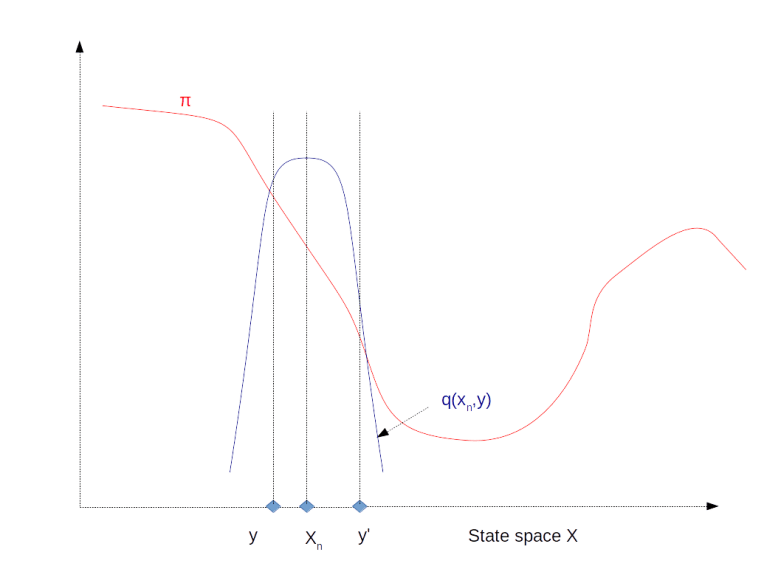
SymmetricMetropolisHastings

The image above illustrates this procedure. The red graph displays the distribution \pi. If our algorithm is currently at step xn, the purpose is to move “up-hill”, i.e. to the left in our example. If we draw a point like y from q which goes already in the right directory, we will always accept this proposal and move to y. If, however, we draw a point like y’, at which \pi is smaller, we would accept this point with a non-zero probability. Thus if we have reached a local maximum like the one on the right hand side of the diagram, there is still a chance that we can escape from there and move towards the real maximum to the left.

In this form, the algorithm is extremely easy to implement. All we need is a function propose that creates the next proposal, and a function p that calculates the value of the probability density \pi at some point. Then an implementation in Python is as follows.

import numpy as np
chain = []
X = 0
chain.append(X)
for n in range(args.steps):
  Y = propose(X)
  U = np.random.uniform()
  alpha = p(Y) / p(X)
  if (U <= alpha):
    X = Y
  chain.append(X)

In the diagram below, this algorithm has been applied to a Cauchy distribution with mode zero and scale one, using a normal distribution with mean x and standard deviation 0.5 as a proposal for the next location. The chain was calculated for 500.000 steps. The diagram in the upper part shows the values of the chain during the simulation.

Then the first 100.000 steps were discarded and considered as "burn-in" time for the chain to stabilize. Out of the remaining 400.000 sample points, points where chosen with a distance of 500 time steps to obtain a sample which is approximately independent and identically distributed. This is called subsampling and typically not necessary for Monte Carlo integration (see [2], chapter 1 for a short discussion of the need of subsampling), but is done here for the sake of illustration. The resulting subsample is plotted as a histogramm in the lower left corner of the diagram. The yellow line is the actual probability density.

MetropolisCauchySample

We see that after a few thousand steps, the chain converges, but continues to have spikes. However, the sampled distribution is very close to the sample generated by the Python standard method (which is to take the quotient of two independent samples from a standard normal distribution).

In the diagram at the bottom, I have displayed how the integral of two functions (\sin(x) and \cos(x)) approximated using the partial sums develops over time. We see that even though we still have huge spikes, the integral remains comparatively stable and converges already after a few thousand iterations. Even if we run the simulation only for 1000 steps, we already get close to the actual values zero (for \sin(x) for symmetry reasons) and \approx 0.3678 (for \cos(x), obtained using the scipy.integrate.quad integration routine).

In the second diagram in the middle row, I have plotted the autocorrelation versus the lag, as an indicator for the failure of the sample points to be independent. Recall that for two samples X and Y, the Pearson correlation coefficient is the number

\frac{E((X-\bar{X})(Y-\bar{(Y)})}{\sigma_X \sigma_Y}

where \sigma_X and \sigma_Y are the standard deviations of X and Y. In our case, given a lag, i.e. a number l less than the length of the chain, we can form two samples, one consisting of the points X_0, X_2, \dots and the second one consisting of the points of the shifted series X_l, X_{l+1}, X_{l+2}, \dots. The autocorrelation with lag l is then defined to be the correlation coefficient between these two series. In the diagram, we can see how the autocorrelation depends on the lag. We see that for a large lag, the autocorrelation becomes small, supporting our intuition that the series and the shifted series become independent. However, if we execute several simulation runs, we will also find that in some cases, the convergence of the autocorrelation is very slow, so care needs to be taken when trying to obtain a nearly independent sample from the chain.

In practice, the autocorrelation is probably not a good measure for the convergence of a Markov chain. It is important to keep in mind that obtaining an independent sample is not the point of the Markov chain – the real point is that even though the sample is autocorrelated, we can approximate expectation values fairly well. However, I have included the autocorrelation here for the sake of illustration.

This form of proposal distributions is not the only one that is commonly used. Another choice that appears often is called an independence sampler. Here the proposal distribution is chosen to be independent of the current location x of the chain. This gives us an algorithm that resembles the importance sampling method and also shares some of the difficulties associated with it – in my notes on Markov chain Monte Carlo methods, I have included a short discussion and a few examples. These notes also contain further references and a short discussion of why and when the Markov chain underlying a Metropolis-Hastings sampler converges.

Other variants of the algorithm work by updating – in a high-dimensional space – either only one variable at a time or entire blocks of variables that are known to be independent.

Finally, if we are dealing with a state space that can be split as a product X_1 \times X_2, we can use the conditional probability given either x1 or x2 as a proposal distribution. Thus, we first fix x2, and draw a new value for x1 from the conditional probability for x1 given the current value of x2. Then we move to this new coordinate, fix x1, draw from the conditional distribution of x2 given x1 and set the new value of x2 accordingly. It can be shown (see for example [5]) that the acceptance probability is one in this case. So we end up with the Gibbs sampling algorithm that we have already used in the previous post on Ising models.

Monte Carlo sampling methods are a broad field, and even though this has already been a long post, we have only scratched the surface. I invite you to consult some of the references below and / or my notes for more details. As always, you will also find the sample code on GitHub and might want to play with this to reproduce the examples above and see how different settings impact the result.

In a certain sense, this post is the last post in the series on restricted Boltzmann machines, as it provides (at least some of) the mathematical background behind the Gibbs sampling approach that we used there. Boltzmann machines are examples for stochastic neuronal networks that can be applied to unsupervised learning, i.e. the allow a model to learn from a sample distribution without the need for labeled data. In the next few posts on machine learning, I will take a closer look at some other algorithms that can be used for unsupervised learning.

References

1. N. Metropolis,A.W. Rosenbluth, M.N. Rosenbluth, A.H. Teller, E. Teller, Equation of state calculation by fast computing machines, J. Chem. Phys. Vol. 21, No. 6 (1953), pp. 1087-1092
2. S. Brooks, A. Gelman, C.L. Jones,X.L. Meng (ed.), Handbook of Markov chain Monte Carlo, Chapman Hall / CRC Press, Boca Raton 2011
3. W.K. Hastings, Monte Carlo sampling methods using Markov chains and their applications, Biometrika, Vol. 57 No. 1 (1970), pp. 97-109
R.M. Neal, Probabilistic inference using Markov chain Monte Carlo methods, Technical Report CRG-TR-93-1, Department of Computer Science, University of Toronto, 1993
5. C.P. Robert, G. Casella, Monte Carlo Statistical Methods,
Springer, New York 1999